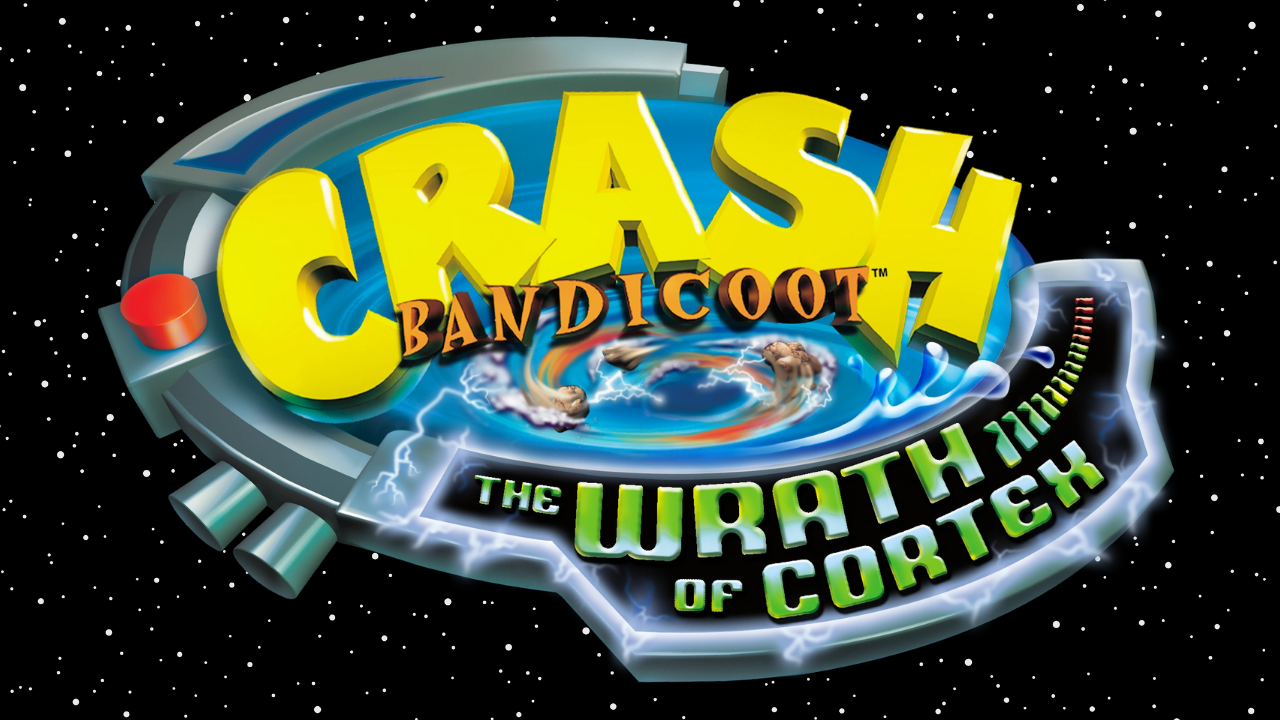
PPI: 72 (B Tier — Good)
Abstract – The Wrath of Cortex is a transitional game — not a defining one. It carries the DNA of the original Crash trilogy but struggles to evolve meaningfully in a post-PS1 era. While the core platforming remains solid and familiar, the lack of innovation and inconsistent execution hold it back. This is a competent continuation, not a progression.
Storyline – Crash Bandicoot: The Wrath of Cortex follows Crash and Coco as they once again face off against Dr. Neo Cortex, who has teamed up with the elemental masks known as the Elementals. These ancient beings are unleashed to wreak havoc across the world, forcing Crash to travel through various themed environments to collect crystals and restore balance. The structure remains consistent with previous entries — a globe-trotting adventure through distinct worlds — but the stakes are elevated slightly through the inclusion of the Elementals and Cortex’s expanded ambitions.
Story & Writing — 6.5/10
The story functions exactly as intended — but never rises above its role.
This is a classic Crash narrative: simple, direct, and built entirely to support gameplay. The inclusion of the Elementals adds a layer of variety to the villain structure, but they lack depth and presence, feeling more like thematic devices than actual characters. Dialogue and characterization remain minimal, leaning heavily on the franchise’s established tone rather than building anything new.
There’s nothing structurally broken here. The story is coherent, consistent, and easy to follow. But it also doesn’t attempt to evolve the formula or deliver anything memorable. It exists to move the player from level to level — and nothing more.
Execution — 7/10
Execution is where the game shows both its strengths and its limitations.
At its core, the traditional Crash platforming formula still works. Linear level design, obstacle timing, and pattern recognition remain satisfying when the game sticks to what made the series successful. However, the attempt to expand gameplay variety introduces inconsistency. Vehicle sections, mech suits, and alternate gameplay styles feel less refined than the standard platforming, often disrupting pacing rather than enhancing it.
Level design can also feel uneven. Some stages are tightly constructed and engaging, while others rely too heavily on repetition or gimmicks that don’t fully land. The game functions, but it lacks the precision and polish that defined the original trilogy.
Engagement — 7.5/10
The game remains engaging — but not consistently.
There’s a baseline level of fun that comes from the Crash formula itself. The challenge, the rhythm of movement, and the satisfaction of completing difficult platforming sections still deliver. For fans of the series, that core loop is enough to maintain interest.
However, the inconsistent gameplay segments and lack of meaningful progression reduce long-term engagement. The game doesn’t introduce enough new ideas to keep players fully invested throughout its runtime. It holds attention, but rarely commands it.
Technical Quality — 7/10
Technically, The Wrath of Cortex is solid — but clearly a step behind its contemporaries.
The transition to the PlayStation 2 brings improved visuals and larger environments, but the game doesn’t fully capitalize on the hardware. Character models and animations are decent, but not standout, and some environments feel visually flat compared to other platformers of the era.
Performance is generally stable, though load times and occasional clunkiness in controls can break immersion. Nothing here is broken, but very little feels cutting-edge. It meets expectations without exceeding them.
Impact & Originality — 6.5/10
This is where the game struggles the most.
The Wrath of Cortex does very little to push the Crash franchise forward. It follows the blueprint established by the Naughty Dog trilogy almost too closely, without introducing meaningful innovation. At a time when platformers were evolving rapidly, this game chose to stay safe.
Its impact is limited as a result. It’s remembered as a continuation rather than a milestone — a game that maintained the brand, but didn’t redefine it. In a genre driven by creativity, playing it safe comes at a cost.
Comments